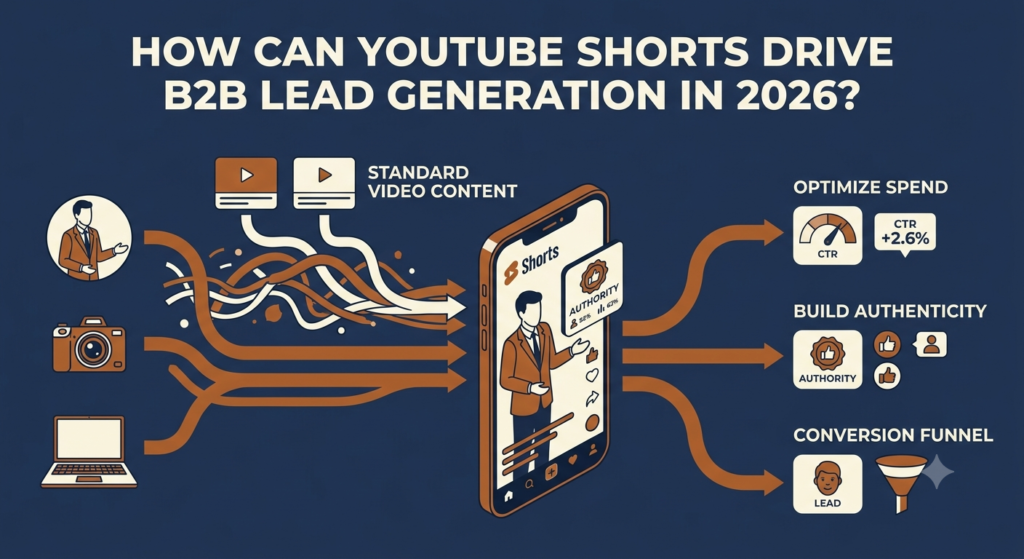
YouTube Shorts is underused by B2B brands. Most B2B marketing teams treat YouTube as the place where long-form webinars and product demos live, ignoring Shorts. This leaves opportunity on the table: Shorts drives subscribers, surfaces in regular YouTube search results, and feeds long-form views through related video recommendations.
This guide covers practical YouTube Shorts strategy for B2B brands: content patterns, integration with long-form, and the measurement framework that ties Shorts to pipeline.
Why YouTube Shorts matters for B2B
Three reasons Shorts deserves attention from B2B marketing teams:
YouTube Shorts surfaces in regular YouTube search results, not just the Shorts feed. A 45-second Short answering a specific B2B question can rank on YouTube for that query alongside long-form videos, often outperforming them.
Shorts drives subscribers to the channel. New subscribers from Shorts then receive long-form video notifications, building cumulative channel audience.
YouTube embeds in Google search results. Shorts can rank in Google Search SERPs for relevant queries, particularly in video carousels and the right-side knowledge panel.
The investment is small compared to long-form video production. A 45-second Short can be produced in 30 to 90 minutes including editing. Long-form B2B videos often take days.
Content patterns that work for B2B
The B2B Shorts content patterns we have tested across client accounts:
Single-tip explainers. One specific tip per Short. “How to set up DKIM in Google Workspace in 30 seconds.” Practical, immediately useful, highly searchable.
Tool walkthrough snippets. 45-second walkthroughs of using a specific tool feature. Pull from longer demos. Each snippet earns its own search traffic.
Definition explainers. “What is MEDDIC sales methodology?” “What is product-led growth?” Definitional Shorts that explain a specific concept clearly.
Mistake call-outs. “3 things wrong with your cold email sequence.” Counterintuitive or contrarian observations that earn comments and engagement.
Behind-the-scenes from the company. Office tours, team meetings, founder commentary. Lower commercial intent but builds brand familiarity.
What works less well: heavily branded product promos, motivational corporate content, content recorded as if for a corporate website rather than a casual social feed.
Production approach
YouTube Shorts production for B2B does not require studio quality. The pattern most B2B founders and marketing teams adopt:
Phone camera with a basic tripod. iPhone or recent Android camera quality is sufficient.
Simple lighting. Daylight from a window or a single ring light. Avoid harsh overhead office lighting.
Lavalier microphone for clean audio. Phone microphones pick up too much ambient noise. A lav mic at 30 to 80 dollars dramatically improves audio quality.
Editing through CapCut (free), Descript (transcribes and edits like text) or Final Cut Pro for more advanced users. Captions burned in (most viewers watch without sound).
Vertical 9:16 framing throughout. Shoot vertical, edit vertical.
Long-form integration
The full value of YouTube Shorts emerges when integrated with long-form video. The pattern:
Record long-form first. A 20-minute deep-dive on a topic, recorded once.
Extract 6 to 12 Shorts from the long-form. Each Short covers one specific moment, tip, or insight from the longer video.
Publish long-form to the main channel. Publish Shorts daily or every other day over 2 to 3 weeks.
Link from Shorts to long-form in the pinned comment, end screen, or description. Drives subscriber growth and long-form views.
YouTube’s algorithm rewards channels that mix long-form and Shorts content. Channel-level engagement signals strengthen both formats.
Posting cadence
For B2B channels:
2 to 4 Shorts per week, consistent. Better to maintain 2 weekly for 12 months than to post 5 weekly for 4 weeks then disappear.
1 long-form video every 2 to 4 weeks. Aim for 8 to 15 minute videos covering specific topics in depth.
Best posting times for B2B: weekdays during work hours in the target audience’s timezone. Less critical than Reels because YouTube search drives more views over time than feed surfacing.
Keyword strategy and titling
YouTube Shorts ranks in search like regular videos. Title strategy:
Use exact-match search phrases when possible. “How to set up Meta Conversions API” reads more naturally than the title “Conversion API Setup Tutorial”.
Keep titles under 60 characters. Mobile-friendly.
Use brackets or symbols sparingly. “[Tutorial]” or “(Quick Guide)” can hurt CTR.
Question-format titles often work well: “What is server-side tagging?” “Why did my CTR drop in 2026?”
Description should include 1 to 3 sentences with target keywords, plus a link back to longer-form content (long-form video, blog post, free resource).
Comments as a content extension
YouTube comments under Shorts are an underused asset. Patterns:
Pin a substantive comment with additional context. The pinned comment shows to all viewers and often gets more engagement than the video.
Respond to every comment in the first 24 hours. Engagement signals to the algorithm. Builds community.
Use pinned comments to link to specific resources. “Here is the full template I mentioned: [link].” Drives traffic to the brand site or lead capture.
Measurement for B2B
YouTube Shorts to B2B pipeline attribution is imperfect. Practical measurement:
Subscribers gained. Track week-over-week subscriber growth and source (YouTube Studio Analytics shows Shorts vs long-form).
Long-form views from Shorts viewers. YouTube Studio shows the percentage of long-form views that came from Shorts. Healthy channels see 5 to 20 percent overlap.
Brand search lift. Brand query volume in Google Search Console and YouTube searches for branded terms increase as channel visibility grows.
Direct traffic to landing pages. Shorts often drive viewers to brand sites later. Direct traffic to lead capture pages from organic users grows as YouTube presence grows.
Pipeline contribution. Track first-touch source on closed deals in HubSpot or Salesforce. YouTube Shorts often appears as either the first or middle touch in B2B deal cycles 6 to 18 months after content publication.
What to expect
Realistic timelines for B2B Shorts:
Months 1 to 3: 50 to 500 views per Short on average. Subscriber growth modest. Channel building topical authority.
Months 4 to 8: Top Shorts begin reaching 5,000 to 50,000 views. Subscriber growth accelerates. Long-form video views grow alongside Shorts views.
Months 9 to 18: Established Shorts channel with predictable view distribution. Top Shorts regularly reach 100,000 plus views. Long-form videos benefit from Shorts-driven subscriber growth, often reaching 5,000 to 50,000 views each.
Pipeline contribution typically appears 12 to 24 months after consistent publishing begins. YouTube is the slowest-compounding channel we work with but also the most durable. Videos published in 2022 still drive traffic in 2026.