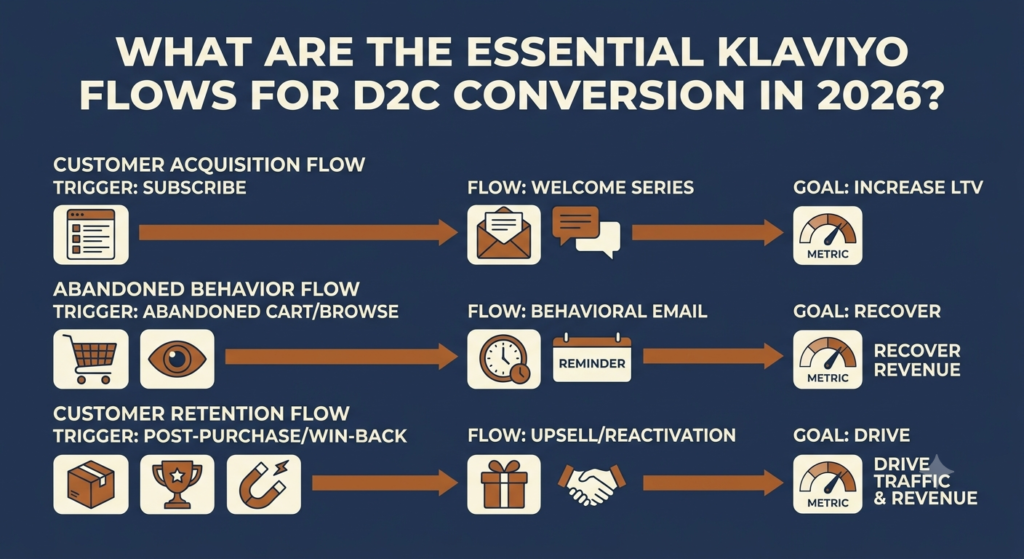
For healthy D2C ecommerce brands in 2026, email and SMS contribute between 25 and 40 percent of total revenue. Most of that comes from a small set of automated flows running quietly in the background. This guide covers the 8 must-have Klaviyo flows we set up for every D2C client, with specific triggers, content patterns and expected revenue contribution from each.
Flow 1: Welcome series
Triggered when a new subscriber joins through pop-up, footer signup or checkout opt-in. Structure: 4 to 6 emails over 10 to 14 days. Email 1 immediately delivers the signup incentive. Emails 2 to 4 introduce the brand story, hero products and customer reviews. Emails 5 to 6 push toward first purchase with sense of urgency.
Revenue contribution: 8 to 15 percent of total email revenue. Typically 10 to 20 percent of subscribers convert to first purchase within the welcome series window. The subject line of email 1 carries the highest open rate of any email in the brand’s history because the user just signed up. Make the offer prominent.
Flow 2: Browse abandonment
Triggered when a user views a product 2 or more times in a session but does not add to cart. Klaviyo’s Active on Site feature tracks this through the Klaviyo JavaScript tag.
Structure: Single email 4 to 6 hours after browsing ends. Reference the specific products viewed. Show customer reviews and social proof. Revenue contribution: 3 to 8 percent of total email revenue. Timing matters: too quickly feels stalkerish, too late and intent has cooled.
Flow 3: Cart abandonment
Triggered when a user adds to cart but does not complete checkout within 1 hour. Structure: 3 emails over 48 hours. Email 1 at 1 hour reminds and recovers with simple reminder and link to cart. Email 2 at 24 hours overcomes objections (shipping included, return policy, reviews). Email 3 at 48 hours offers a small discount to recover the sale.
Revenue contribution: 10 to 20 percent of total email revenue. The highest-ROI flow in most accounts. Do not lead with a discount in email 1. Many users complete purchase without needing a discount when simply reminded. Reserve discounts for email 3.
Flow 4: Checkout abandonment
Triggered when a user begins checkout (enters email) but does not complete. Higher intent than cart abandonment because the user committed identity.
Structure: 2 emails over 24 hours. Email 1 at 30 minutes with direct “complete your order” CTA. Email 2 at 24 hours with urgency or discount push. Revenue contribution: 5 to 12 percent of total email revenue. Bypass the cart and link directly to checkout if possible.
Flow 5: Post-purchase
Triggered immediately after a purchase, continues over 30 to 60 days. Structure for first-time buyer: Email 1 confirms order with shipping expectations. Email 2 (3 to 5 days after shipping) checks in with usage tips. Email 3 (10 to 14 days) requests product review. Email 4 (21 to 30 days) cross-sells complementary products.
For repeat buyers, simpler: order confirmation, shipping update, review request. Revenue contribution: 12 to 25 percent of total email revenue from the cross-sell components. Review collection has indirect impact through social proof. Timing of cross-sell matters: too soon feels pushy, wait until the customer has used the original product before suggesting complementary items.
Flow 6: Replenishment
For consumable products (skincare, supplements, food, household). Triggered based on expected product use cycle. Predict when the customer is likely running out based on average reorder time for that product (typically 30, 60 or 90 days). Send 1 reminder a few days before expected runout, 1 follow-up a week after expected runout if no reorder.
Revenue contribution: 8 to 18 percent of total email revenue for brands with consumable products. Predict accurately. Klaviyo’s Predictive Analytics handles this automatically when given enough data.
Flow 7: Win-back
Triggered when a customer has not purchased in a defined window (typically 90 to 180 days, depending on category). Structure: 3 emails over 14 days. Email 1 acknowledges the absence and shares new products since last purchase. Email 2 offers a returning customer discount. Email 3 is a final push with stronger offer or notice that the offer is ending.
Revenue contribution: 4 to 8 percent of total email revenue. Lower per-email conversion but recovers significant otherwise-lost customers. Segment by past purchase value: VIP customers get a higher-value win-back offer than lower-spending customers.
Flow 8: VIP and loyalty
Triggered for customers crossing a defined LTV threshold (typically 2 purchases or 300 dollars cumulative spend). Welcome to VIP email with exclusive perks. Periodic exclusive offers monthly. Birthday or anniversary gifts.
Revenue contribution: 5 to 10 percent of total email revenue, but VIP customers spend 4 to 8 times more than average. The flow protects and grows the highest-value customer segment. VIP perks should be meaningful, not token gestures. Early access to new products, exclusive bundles, free express shipping work better than small members-only discounts.
SMS integration
Layer SMS for higher-conversion moments. Cart abandonment SMS at 4 to 6 hours converts 5 to 10 times higher than email. Post-purchase shipping updates via SMS. VIP exclusive offers via SMS create urgency. Replenishment SMS reminders work for time-sensitive reorder windows.
Compliance: explicit SMS opt-in required separate from email. Klaviyo SMS, Postscript or Attentive all handle compliance.
What to expect
For a D2C brand doing 200,000 dollars monthly revenue with these 8 flows running properly: email and SMS contribute 30 to 40 percent of revenue, typically 60,000 to 80,000 dollars monthly from automated flows alone.
Setup time for the full flow library: 4 to 8 weeks. Most ROI comes from cart and checkout abandonment, so prioritise those first. Ongoing maintenance: quarterly review and optimisation. The flows compound when actively managed.