Meta recommends 30 to 50 creative variants per ad set per month for proper optimisation. Google Performance Max needs at least 15 image, 5 video and 20 text assets per asset group. Most brands produce 5 to 10 creative variants per month total, leaving the algorithm undersupplied and performance below potential.
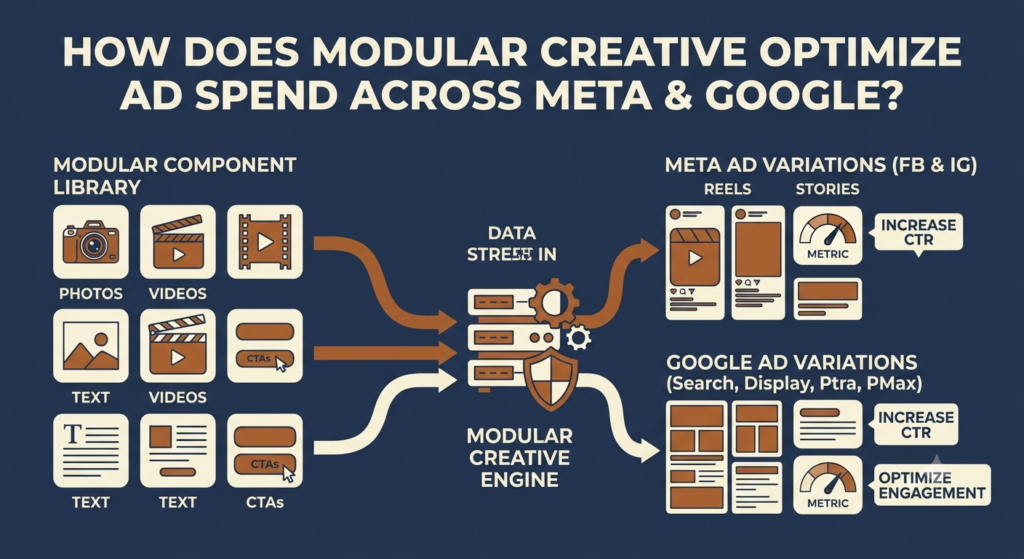
Modular ad creative solves the volume problem by treating creative as a system of swappable parts rather than one-off productions. This guide covers the modular framework, production workflow and patterns that scale testing without proportionally scaling production cost.
The modular framework
Treat creative as combinations of independent variables. Hooks: the opening message that grabs attention. Question, statistic, contrarian claim, benefit promise. 4 to 8 hook variants per campaign. Visual frames: the base visual template. Product on background, lifestyle shot, before-after, talking head, demo. 4 to 6 frames per campaign. Copy variants: headline and body copy. 6 to 10 variants per campaign. CTAs: “Shop Now”, “Get Yours”, “See Why”, “Learn More”. 3 to 5 variants per campaign.
Combination math: 6 hooks by 5 visual frames by 8 copy variants by 4 CTAs equals 960 possible combinations. Real production tests 30 to 50 strategically, but the system enables that volume without proportional cost.
Production workflow
Week 1: Strategy session. Define campaign objectives, audiences, value propositions. Brief the creative team on hooks and angles. Week 2: Concept development. Hook list, visual concepts, copy variants. Week 3: Production batch. Photography or video shoot producing 30 to 60 raw assets. Week 4: Editing and adaptation. Editors produce final creative in all required dimensions (1:1, 4:5, 9:16, 16:9 for Meta placements; 1:1, 16:9 for Google).
Week 5 to 8: Test in market. Push 20 to 30 variants live. Monitor daily. Pause underperformers after 3 to 5 days. Promote winners to higher spend. Repeat monthly. Each cycle produces 30 to 60 new variants while previous winners continue running.
Visual frames that work
The frames that consistently outperform across categories: Product hero with text overlay. Before-after split visual transformation. Customer lifestyle showing real use. Demonstration video (15 to 30 seconds, vertical, captioned). Founder direct address. Comparison visual (side-by-side). Reaction video (UGC-style, less polished, more authentic).
Hook libraries
Hook patterns that produce strong CTR. For D2C beauty: “The skincare mistake costing women under 40”, “What dermatologists actually use”. For D2C apparel: “The piece that completes 5 outfits”, “Why this is selling out”. For B2B SaaS: “Why we cancelled our competitor”, “The metric we have been tracking wrong”. For lead generation: “Free framework that took us 3 months to build”, “12 signs your funnel needs help”.
Build a hook library specific to your category over time. Test, learn, refine.
Static vs video mix
Static images: faster to produce, cheaper. Work well for retargeting and well-known products. Strong for hero shots, infographics, quick-read messaging. Video: better for awareness, emotional connection, complex products. Required for Reels, Shorts and TikTok. Typical mix: 60 to 70 percent video, 30 to 40 percent static. Adjust by category.
AI tools for production scale
Pebblely, Stable Diffusion, Midjourney for AI-generated product photography backgrounds. Captions.ai, Submagic, Eddie AI for automatic captions on videos. Runway ML for video editing automation. Descript for transcript-based video editing. Figma and Canva for static creative templates. These reduce per-variant production time without replacing strategy and concept work.
Testing methodology
Launch 8 to 15 new variants per ad set at a time. Smaller batches risk insufficient data; larger batches dilute spend per variant. Run 3 to 7 days minimum before declaring winners. Performance threshold: variants spending 100 dollars or more with conversion rate or ROAS below 70 percent of account average get paused. Promising variants get budget increases.
What to expect
For a brand spending 50,000 dollars monthly on Meta and Google ads: production output target of 30 to 50 new variants per month. Production cost 15,000 to 30,000 dollars monthly for proper modular creative at this volume. Brands implementing modular creative see 25 to 50 percent improvement in cost per conversion within 90 days versus prior production cadence. Creative fatigue significantly reduces.