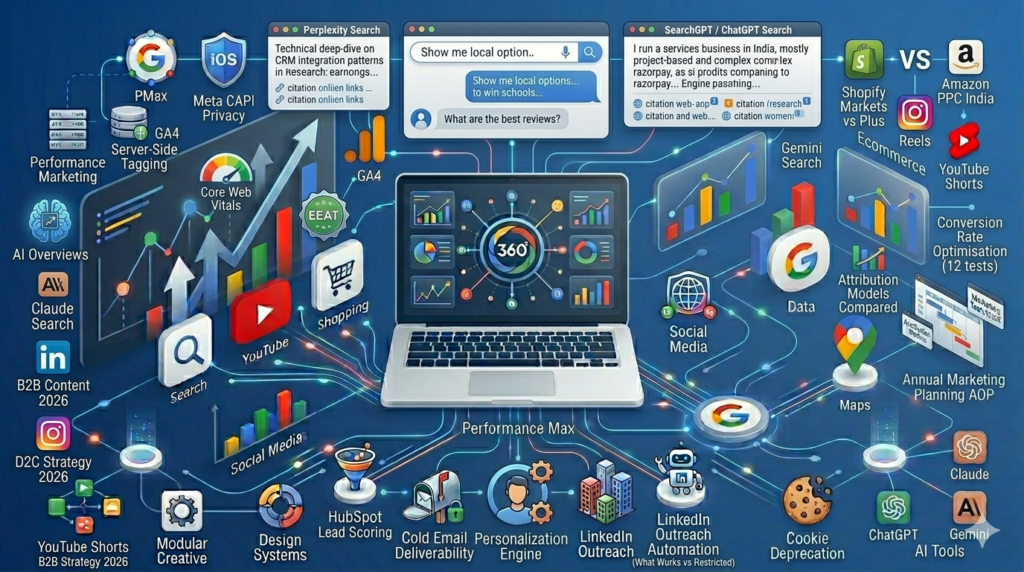
Search behaviour in 2026 looks measurably different from search in 2022. Google still holds the majority of search traffic, but ChatGPT, Perplexity, Claude and Gemini together account for roughly 8 to 12 percent of searches that would have gone to traditional engines (Sparktoro and SimilarWeb data, Q1 2026). Within Google itself, AI Overviews and AI Mode have changed how users interact with results. Query lengths have grown. Click-through rates have dropped. Brand visibility patterns have shifted.
This guide covers what has actually changed in search behaviour, what marketers should track, and how to adapt strategies for the new landscape.

The new search ecosystem
Where searches now go in 2026: Google traditional search still leads at roughly 80 percent of total search volume. Google AI Mode accounts for about 8 to 12 percent of Google searches and growing. ChatGPT search (including SearchGPT) takes roughly 4 to 6 percent of what would have been Google search volume. Perplexity holds about 1 to 2 percent, focused on research queries. Claude and Gemini together account for 1 to 2 percent.
The shares matter less than the patterns. AI search is taking the queries that were always poorly served by classic web search: complex multi-part questions, comparison research, technical deep-dives, conversational exploration.
Query length and structure
Classic Google search queries average 3 to 5 words. AI search queries average 12 to 25 words. Users adapt their query patterns to the interface. With AI, they ask full questions including context.
Example contrast: Classic Google search: “best CRM small business”. AI search: “I run a 25-person services business in India, mostly project-based work, and we need a CRM that integrates with Razorpay and lets us track project milestones. What should we look at?”.
The implication for SEO: long-tail keyword research becomes more important. Tools like AlsoAsked, Answer the Public, and Google’s People Also Ask remain useful. They need to be paired with mining of actual conversational queries from customer support tickets, sales call recordings and community discussions.
Zero-click reality
Click-through rates on classic Google search have dropped on queries where AI Overviews appear. Position 1 CTR fell 34 to 58 percent on informational queries with AIOs present (Ahrefs, November 2025). Seer Interactive measured 93 percent zero-click behaviour on AI Mode queries.
Total organic traffic for most brands is flat or down 5 to 25 percent in 2026 versus 2024 baseline, even when impressions are up. The interface answers the query without sending the user to a site.
Implications: brand visibility (impressions, citations in AI responses) matters more relative to traffic. Direct traffic and branded search become leading indicators of AI-driven brand recognition. Conversion rate from organic traffic typically improves because users who do click through have higher intent.

ChatGPT and Perplexity traffic
The AI engines that drive referral traffic differ from Google AI Mode (which mostly does not drive traffic). ChatGPT search includes citation links that users click through to. Perplexity has built citation visibility into its interface. Claude’s web search feature similarly provides linked sources.
Traffic from these sources converts at 8 to 18 percent compared to 2 to 4 percent for traditional Google organic (multiple brand reports through 2025 and 2026). Users coming from AI engines arrive pre-qualified, having already received a summary answer and clicked through specifically for depth.
Tracking this traffic: GA4’s traffic source reports identify Perplexity, ChatGPT and Claude as referral sources. Most of these searches appear as “perplexity.ai”, “chat.openai.com”, or similar referrers. Set up referral source classification to bucket them as “AI Engines” segment.
Brand entity visibility
AI search rewards brand recognition. Models cite established brands more often than unknown ones. The brand-building activities that matter most for AI visibility:
Wikipedia and Wikidata presence. Single highest signal of entity recognition. Wikipedia notability is a high bar; Wikidata is more accessible.
Consistent brand mentions across high-authority sources. Each citation strengthens entity associations the AI uses.
Author entity recognition. Named authors with LinkedIn presence, conference talks, podcast appearances get cited disproportionately.
Schema.org markup at scale. Organization, Person, Article, Product schema with sameAs properties pointing to verified profiles.
What marketers should track now
Traditional SEO metrics are no longer sufficient. The dashboard worth building in 2026:
Traditional metrics: organic traffic by source, impressions, average position, CTR.
AI visibility metrics: AI Overview citation count (track manually or through tools like Otterly, Profound, SE Ranking AI tracker). Perplexity referral traffic. ChatGPT referral traffic. Brand entity mentions across the web (Brand24, Mention).
Branded search trends: branded query volume in Google Search Console. Direct traffic week over week. Branded social mentions. All proxy indicators of AI-driven brand visibility.
Conversion quality metrics: conversion rate from organic traffic. Conversion rate from AI engine referral traffic. Time on site from AI traffic vs classic Google traffic.
Content patterns that work
For both AI citation and human readers, the patterns that perform consistently:
Answer-first paragraphs after each heading. The most important answer comes immediately, then context follows. AI models extract the direct answer.
Tables for comparisons. AI engines synthesise tabular data directly into responses.
FAQ blocks with question-answer pairs. Match natural query phrasing.
Specific statistics with attribution. AI engines prefer cite-able numbers over general claims.
Original data and research. Models reward content that contains information not found in the top 10 results.
Multi-page topical depth on a single domain. AI engines synthesise across pages from the same source when the source has demonstrated authority.
What does not work anymore
Keyword density optimisation. The models are sophisticated enough to recognise topic relevance without keyword matching.
Generic long-form content covering broad topics shallowly. AI summarises what is shallow; nothing gets cited.
Hidden content (collapsed sections, accordion content). AI engines often miss content that is not visible by default.
AI-generated content optimised for AI search. The models detect AI patterns. Genuine expertise gets cited.
What to expect
The shift from click-based to citation-based brand visibility continues through 2026 and beyond. Traffic patterns stabilise around 15 to 30 percent reduction in classic Google organic traffic, offset by 5 to 15 percent of new traffic from AI engines.
Brands that adapt to citation-based visibility outperform brands chasing recovery of pre-AI traffic levels. The economics improve (higher conversion rate per visitor) even as traffic volume changes. Plan for the trade-off, not against it.