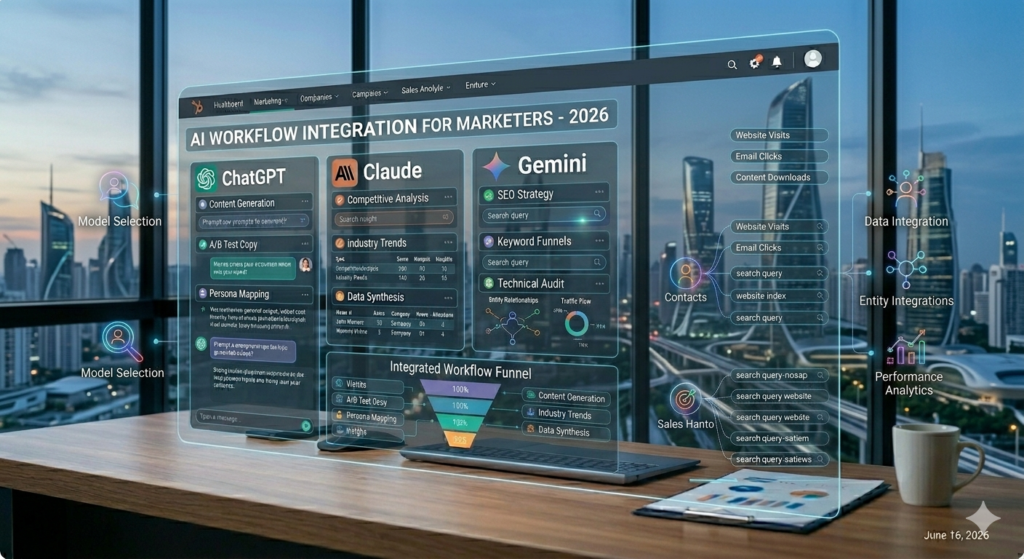
By 2026, ChatGPT, Claude and Gemini are standard marketing tools. The question is no longer whether to use AI but which model for which task, how to integrate them into actual workflows, and where they create value versus where they create new problems. This guide covers the practical workflow patterns we use across marketing teams.
The three models compared
ChatGPT (OpenAI GPT-5 series). Strongest general-purpose model. Best for: ad copy variations, social media drafts, broad content ideation. Highest tool integration (DALL-E for images, Code Interpreter for data, web search). Subscription: ChatGPT Plus 20 dollars monthly individual, Team and Enterprise tiers higher.
Claude (Anthropic). Strongest for nuanced writing, long-form content, brand voice consistency. Best for: long-form blog drafts, brand voice work, analysis and reasoning tasks. Larger context window than competitors (200K plus tokens) for working with long documents. Subscription: Claude Pro 20 dollars monthly, Team and Enterprise tiers higher.
Gemini (Google). Best integration with Google Workspace. Strong for: research-heavy tasks (deep search integration), Workspace integration (Docs, Sheets, Gmail), multimodal tasks (images plus text together). Available through Gemini Advanced or as part of Google Workspace Business plans.
Most marketing teams use 2 or 3 in combination. Pick the right tool per task type.
Workflows by marketing function
Content marketing
Long-form blog drafts: Claude. The longer context window and stronger writing quality outperform competitors on multi-thousand-word drafts. Workflow: Provide brief, target keyword, voice samples and example posts from your site. Claude produces a first draft. Human editor revises, adds original insights, strengthens specifics.
Headlines and meta descriptions: ChatGPT. Faster iteration on shorter outputs. Generate 10 to 20 variants, pick the strongest.
Content research: Gemini with deep research mode (introduced 2024, matured through 2025). Generates research briefs by reading dozens of sources. Always verify citations.
Ad copy and creative
Ad copy variants at scale: ChatGPT. Generate 50 to 200 variants quickly. Filter to top 30. Human review for brand voice.
Ad image generation: ChatGPT with DALL-E, Midjourney (separate subscription), or Stable Diffusion. Each has different strengths. DALL-E is most accessible. Midjourney produces strongest visual quality. Stable Diffusion offers most control.
Video script writing: Claude. Better at narrative structure and voice consistency for longer scripts.
Email marketing
Email copy variants: ChatGPT for cold email subject lines and body variations. Claude for longer nurture sequences requiring consistent voice.
Email personalisation: GPT-4 or Claude API integrated through Make, n8n, or Zapier into HubSpot or Klaviyo. Generates personalised first sentences based on prospect’s LinkedIn data, recent company news, or other context.
SEO and content optimisation
Keyword research expansion: ChatGPT or Claude. Provide a seed keyword, request 50 to 100 related queries with intent classification.
Content briefs: Claude. Reads top-ranking competitor pages, generates comprehensive brief including structure, topics, statistics needed.
FAQ generation for AI search optimisation: Either model. Prompt with the target topic and ask for 10 to 15 questions in natural query language with answers under 50 words each.
Analytics and reporting
Data analysis: ChatGPT with Code Interpreter, or Claude with text-based data analysis. Upload a CSV, ask for trend analysis, anomaly detection, summary statistics.
Report writing: Either model. Provide raw data and reporting framework. Model produces draft narrative.
Stakeholder updates: Claude. Produces clearer executive-level writing.
Prompt patterns that work
Role and context first. “You are a senior performance marketer at a B2B SaaS company. We sell to marketing operations managers at companies with 100 to 500 employees…”
Provide examples. Show 2 to 3 examples of the desired output style. AI models learn from examples more than from instructions.
Specify constraints. “150 character maximum. Conversational tone. No buzzwords. No exclamation marks.” Constraints prevent generic output.
Iterate, do not accept first output. The first response is rarely the best. Ask for variations, push back on weak elements, request alternatives.
Add do-not-use lists. “Do not use these words: leverage, robust, delve, synergy, in the realm of.” Saves editorial time.
Integration patterns
Make (formerly Integromat), Zapier, n8n: connect AI to CRM, email platforms, project management tools. Examples: automated lead enrichment, content generation triggered by HubSpot workflow, social media post drafts auto-pushed to Buffer.
Custom GPTs in ChatGPT: build specialised assistants for specific tasks (cold email writer, SEO brief generator, social media scheduler). Tied to your brand voice and constraints.
Claude Projects: similar to Custom GPTs. Set up project with brand guidelines, example content, knowledge base. All conversations within the project use that context.
API integrations for scale: when generation volume exceeds 100 outputs per day, use the API directly through n8n or custom code. Cost per output drops significantly versus chat interface.
What AI is good at vs what it is not
Good at: producing first drafts faster than humans. Generating variants for testing. Summarising long documents. Extracting structured data from unstructured text. Translating text. Generating ideas at high volume.
Not good at: original insights from first-hand experience. Brand voice without significant prompting and editing. Factual accuracy without verification. Strategic thinking that goes beyond the prompt. Replacing senior editorial judgement.
The marketing teams getting value from AI in 2026 use it as a force multiplier, not as a replacement for craft. AI generates 5 to 10 times faster. Humans curate, edit and add what only humans can add.
Quality control patterns
Every AI-generated piece of customer-facing content needs human review. Not as a formality, as substance. Checks: factual accuracy of any specific claims, brand voice alignment, presence of awkward AI tells (excessive transitions, generic conclusions, em dash overuse).
Specific claims should be verified, particularly statistics, dates and quotes. AI models confidently state incorrect facts.
Document the prompts that work. Build a prompt library shared across the team. Saves rebuilding effective prompts repeatedly.
Common AI workflow mistakes
Treating AI as the final author. Output quality drops sharply without human editing.
Using one model for everything. Different models excel at different tasks. Match tool to task.
Skipping the example inputs. Without examples, output reverts to model defaults which read like generic AI text.
Generating without measuring impact. Track which AI-generated assets actually outperform human-written baselines.
What to expect
For marketing teams properly using AI in 2026: content production capacity 3 to 5 times higher than pre-AI baseline. Ad creative testing velocity 5 to 10 times higher. Time savings on routine tasks (research summaries, first drafts, data exploration) of 40 to 60 percent of pre-AI levels.
The teams that struggle with AI are the ones who either over-rely on it (publishing unedited output) or under-use it (manual everything because of skepticism). The middle path, AI as fast-draft tool plus disciplined human editing, produces the strongest results.