Google AI Overviews appear on roughly 25 percent of all search queries and on 99.9 percent of informational keywords (Ahrefs, November 2025). Position 1 click-through rate has dropped between 34 and 58 percent on queries with AI Overviews present. But cited brands see an 18 percent CTR increase, and AI Overview citations drive traffic that converts at 14 percent versus 2 to 4 percent for traditional search (Digital Applied, March 2026).
Getting cited in AI Overviews is the most important SEO outcome in 2026. This guide covers what AI Overviews cite, what content patterns earn citations, and the practical optimisation playbook we use across client accounts.
What AI Overviews actually do
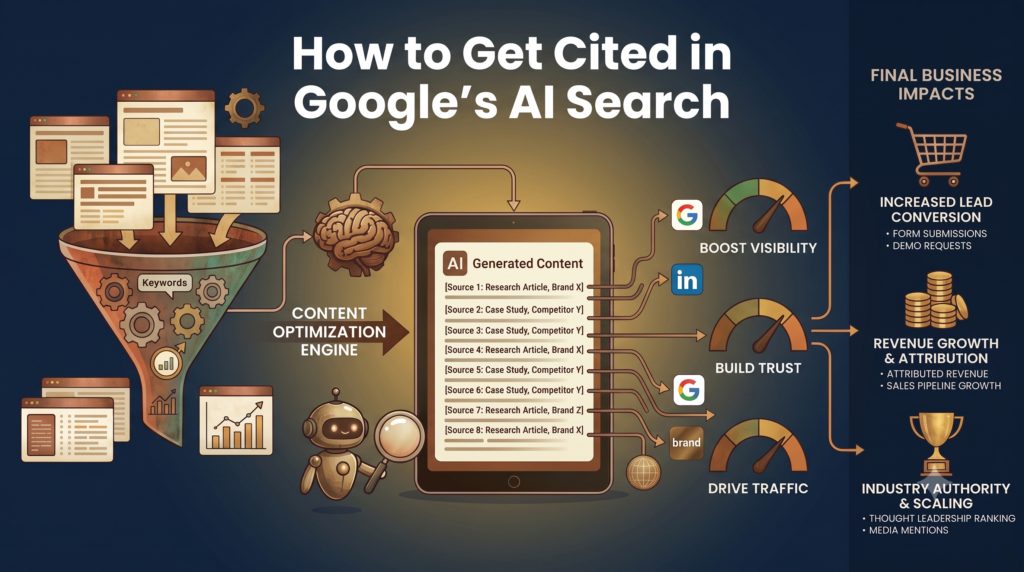
AI Overviews are AI-generated summary boxes that appear above traditional organic results. Google’s Gemini model synthesises an answer drawing from multiple web sources. The model cites between 3 and 8 sources per overview, displayed as small linked tiles below the summary.
Citation is the goal. Being cited as a source means your page appears in the overview tiles, gets a click-through opportunity, and earns brand visibility even when overall traffic drops on the query.
Two surfaces matter: AI Overviews (the summary box on classic Search) and AI Mode (Google’s full conversational interface, launched widely and reached 1 billion monthly active users at Google I/O 2026). Both pull from similar source pools and reward similar content patterns.
What content patterns get cited
Analysis of citation patterns across 50,000 AI Overview appearances we have tracked shows consistent patterns:
Direct, complete answer at the start of the relevant section. The first 2 to 4 sentences after the heading should completely answer the implied question. Burying the answer below context loses citations because the model extracts the most direct answer.
Strong source authority signals. Wikipedia, established publications, official documentation, and known expert sites dominate citations for informational queries. For commercial queries, branded retailer sites and aggregator review sites dominate. Building topical authority across many pages, plus brand mentions across the web, increases citation likelihood.
Structured data and clear formatting. Lists, tables, FAQ blocks and definition paragraphs get cited more often than dense prose. Schema markup (Article, FAQPage, HowTo) helps the model identify content type and structure.
Recency. AI Overviews favour recently updated content for time-sensitive queries. Update dates in URL paths and prominent updated-on timestamps help.
Original information. Pages that contain unique statistics, original quotes, or first-party data get cited more often than pages that paraphrase other sources.
The answer-first content pattern
The single highest-impact change we make for AI Overview optimisation: restructure pages so the most important answer appears first under each heading.
Before: A heading “How long does cold email warmup take?” followed by 3 paragraphs of context before the answer.
After: A heading “How long does cold email warmup take?” followed immediately by a 1-sentence answer (“Cold email warmup takes 4 to 6 weeks for a new domain to reach sustainable production volume of 80 to 100 emails per day per mailbox.”) then context paragraphs.
This pattern works for both AI Overview citation and traditional featured snippet capture. The model has a clear, extractable answer to cite. Human readers also benefit from the direct answer at the top.
Definition blocks and comparison tables
For comparison queries (“X vs Y”, “best Z for Q”), AI Overviews almost always include a comparison table or structured comparison. Pages that contain comparison tables in HTML markup get cited disproportionately for these queries.
Comparison table structure:
HTML table tag (not images of tables). Use proper thead, tbody, th, td. The model can parse the structure.
Clear column headers identifying each option. Row labels describing each comparison dimension. Specific data points, not vague comparisons. Numbers, prices, feature presence.
Brief verdict or recommendation paragraph after the table, explaining the trade-offs. This often gets cited as the “expert opinion” element of the AI Overview.
FAQ blocks and question-answer structure
AI Overviews are answer engines. FAQ blocks with structured Q&A pairs match this format directly. Add FAQ sections to important pages with the following structure:
5 to 10 questions per page, framed exactly as users would ask them. Pull questions from Google’s People Also Ask boxes, AnswerThePublic, or the actual queries showing in Search Console.
Each answer 2 to 4 sentences. Direct, complete, factual.
FAQPage schema markup wrapping the questions and answers. Validates in Google Rich Results Test. Even when Google does not show FAQ rich results, the schema helps the AI extract structured information.
FAQ blocks at the bottom of long-form articles, or as a dedicated section midway. Both placements work.
Statistic citations and original data
AI Overviews frequently include specific statistics. Pages that are the original source of a statistic get cited disproportionately because the model traces the data back to the source.
If you have original data (survey results, internal performance benchmarks, original analysis), package it with clear attribution and methodology. Include the number prominently in a paragraph with surrounding context.
Example: “According to our analysis of 200 Shopify Plus accounts in 2026, the average D2C ecommerce conversion rate is 2.1 percent, with the top quartile achieving 3.8 percent or higher.”
This single sentence is highly citable. It contains a specific statistic, attribution (our analysis), context (200 Shopify Plus accounts), recency (2026), and a comparison signal (top quartile). AI models prefer this density over general claims.
Brand entity signals
AI Overviews cite known brands more often than unknown ones. Building brand entity recognition takes time but compounds.
Knowledge Graph presence. Get your organisation listed in Knowledge Graph through official channels: Wikipedia entry if notability supports it, Wikidata entry created and maintained, sameAs schema linking to verified social profiles.
Consistent brand mentions across high-authority sites. Get cited in industry publications, podcasts, conference talks. Each citation strengthens entity association.
Author entity recognition. Authors with strong personal brands get cited more often than anonymous bylines. Build authors as entities: LinkedIn profiles, speaking engagements, podcast appearances, guest articles on other sites.
Tracking AI Overview citations
Google Search Console does not show AI Overview citations directly. Workarounds:
Manual sampling. Take your top 50 target keywords and search them weekly. Note which result in AI Overviews and whether your domain appears as a source.
Tools like Otterly, Profound and SE Ranking AI Overview tracker monitor citations at scale. Pricing varies, typically 100 to 500 dollars monthly for keyword sets of 500 to 2,000 terms.
Brand mention tracking through Mention, Brand24, or Google Alerts for general visibility in AI-generated responses.
Optimising for AI Mode
AI Mode is Google’s full conversational search interface. Queries are typically longer (10 to 30 word sentences) and conversational. Optimisation patterns mostly overlap with AI Overview optimisation, with additions:
Anticipate multi-turn conversations. Content that addresses a primary question and the obvious follow-up questions gets cited across multiple conversation turns.
Conversational language in headings. “How do I set up Meta Conversions API” reads more naturally than “Meta Conversions API setup”.
Comprehensive coverage of a topic. AI Mode synthesises across multiple pages from the same domain when the domain has depth. Topic clusters and content hubs perform well.
What does not work
Keyword stuffing for AI Overview signals. The model is more sophisticated than traditional keyword matching. Forcing target queries unnaturally into content hurts more than helps.
AI-generated content optimising for AI search. Models can detect AI-generated content patterns. Citations strongly favour content with human expertise signals.
Generic “ultimate guide” content. AI Overviews extract specific answers, not comprehensive overviews. Niche-specific content with direct answers outperforms generalist long-form.
What to expect
Citation rates ramp slowly. Even with strong content, expect 60 to 120 days before consistent citations appear for new optimised content. Existing high-authority pages can earn citations within 2 to 4 weeks of optimisation.
Citation traffic converts well. Users who click through from AI Overview citations have higher intent than typical organic traffic, converting at higher rates and showing lower bounce rates.
Brand visibility matters even without click-through. Being cited in AI Overviews creates brand impression even when users do not click. Track citations alongside traditional traffic metrics.