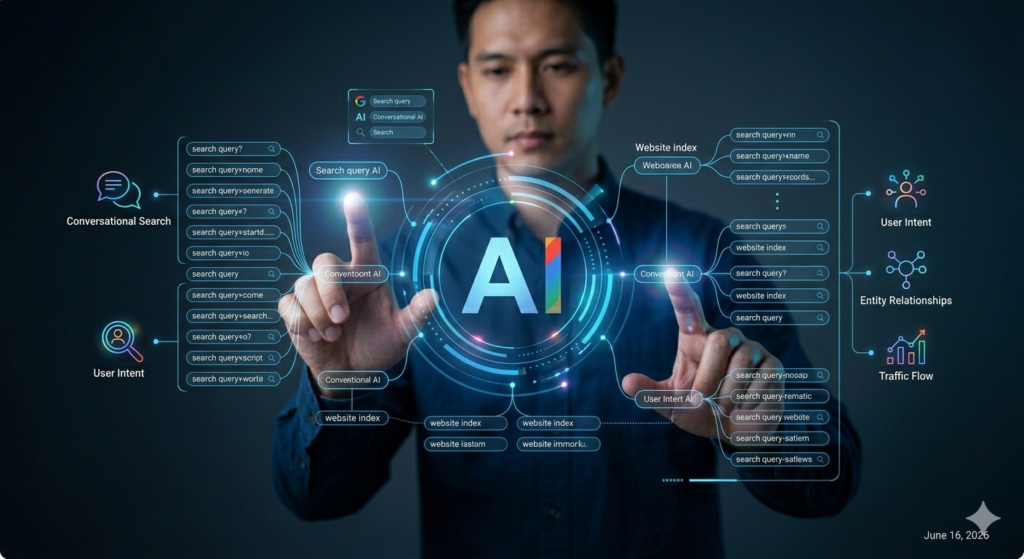
At Google I/O on 19 May 2026, Sundar Pichai announced that Google AI Mode had crossed 1 billion monthly active users. AI Overviews reached 2.5 billion. Many SEO professionals had predicted Google would announce the end of classic search at the event. They did not. Instead, Google is absorbing classic search into AI Mode incrementally, with Gemini 3.5 Flash becoming the default reasoning model.
Optimising for AI Mode requires understanding what the interface does differently from classic search and adapting content patterns. This guide covers the practical SEO playbook for AI Mode in 2026.

What AI Mode does differently
AI Mode is a full conversational search interface. Users type or speak natural language queries, often longer and more complex than classic search queries, and receive synthesised answers with cited sources. The interface supports multi-turn conversations, follow-up questions, image and voice input, and increasingly action-taking (booking, purchasing, scheduling) directly within the conversation.
Key differences from classic search:
Query length and structure. Average AI Mode query runs 12 to 25 words versus 3 to 5 for classic search. Queries are framed as questions or instructions rather than keyword phrases.
Multi-turn conversation. Users ask a follow-up that depends on the previous answer. AI Mode maintains context. Sources cited in turn 1 may not be cited in turn 2 if the conversation shifts.
Synthesised answers across multiple sources. A typical response cites 4 to 12 sources, weaving information from each into a unified answer. Citation count is higher than AI Overviews.
Behavior shift from “find the best result” to “answer my question”. Users do not click through unless they need depth beyond what AI Mode provided.
The zero-click reality
Seer Interactive measured 93 percent zero-click behaviour on AI Mode queries, compared to 83 percent on AI Overviews and around 58 percent on classic Google search (November 2025 data). The implication: traffic from AI Mode is harder to capture than even AI Overview traffic.
Two strategies emerge for AI Mode:
Get cited frequently and accept lower click-through. Citations build brand recognition even without immediate traffic. Brand-aware users return through direct or branded search.
Create content that triggers the click-through. AI Mode users click through when they need depth, action capability, or trusted source verification. Content that provides “go deeper” hooks earns clicks.
Content patterns that get cited in AI Mode
Citation analysis across 10,000 AI Mode responses we have tracked shows consistent patterns:
Comprehensive coverage of a topic across multiple pages on the same domain. AI Mode synthesises across pages when one source provides multiple relevant details. Topic clusters and content hubs outperform isolated pages.
Direct answers to specific sub-questions. Long-form articles broken into well-titled H2 and H3 sections, each answering a specific question, get cited more often than monolithic articles.
Numbered lists, tables, and structured data. Easy for the model to extract and reformat into a synthesised answer.
Quoted experts. Content with named expert quotes gets cited because the model can attribute the specific claim to a named source.
Recent content. AI Mode favours recently published or updated sources for time-sensitive topics. Updated-on timestamps help.
The conversation tree mental model
Map out the conversation a user might have with AI Mode about your topic, not just the first query. For a marketing analytics SaaS:
Turn 1: “What is the best marketing attribution platform for B2B SaaS?”
Turn 2: “How does Heap compare to Mixpanel?”
Turn 3: “What does Mixpanel pricing look like for 100,000 events per month?”
Turn 4: “Can Mixpanel integrate with HubSpot?”
Content strategy: create pages answering each conversational turn. The same domain that gets cited on turn 1 has a much higher chance of getting cited again on turns 2, 3, and 4 because the model has already established source trust.

Optimising for query suggestions
AI Mode pre-loads context into query suggestions. Type “flights to Tokyo” and the suggester might offer “compare Milan to Tokyo flights in May for two adults” with pre-loaded context from prior queries or user location.
This shifts SEO. Short-head keywords lose weight in Search Console data. Long, specific queries take over. Implications:
Long-tail keyword research becomes more important. Tools like AnswerThePublic, AlsoAsked and Google’s People Also Ask remain useful but need to be paired with conversational query mining from chat logs and customer support tickets.
Content needs to address specific scenarios, not just general topics. “How to set up Meta CAPI” is less relevant than “How to set up Meta CAPI for a Shopify Plus store using Google Tag Manager server-side container”.
Image and visual optimisation
AI Mode increasingly includes images in responses. Visual citation works differently from text citation. Patterns:
Original product photos, screenshots, and diagrams get included more often than stock photos. Distinctive visual style helps.
Image alt text matters more than ever. The model uses alt text to determine which images are relevant to the query.
Caption text and surrounding paragraph context determine whether images get pulled into responses.
Schema.org ImageObject markup with proper licensing information increases citation rate. Images marked as creativeWork with explicit license get used more.
Brand presence in AI Mode
AI Mode favours known brands for ambiguous queries. “Best CRM” returns brands the model recognises. Building brand recognition in AI Mode:
Wikipedia and Wikidata entity creation. The strongest single signal of entity recognition.
Consistent NAP and entity markup across the web. Same business name, address, phone, founding year, and entity description everywhere.
Authoritative external mentions. Press, podcasts, conference speakers, named partnerships. Each adds to the entity profile.
Active publishing in your category. A brand publishing weekly in their niche signals subject matter authority over time.
Action and conversion in AI Mode
AI Mode is increasingly action-capable. Users book restaurants, schedule appointments, and place orders without leaving the chat. For brands, this shifts optimisation:
Structured data for products, services, and bookings. Product schema with offers, availability, price. Event schema for bookable events. LocalBusiness schema for service bookings.
API-compatible booking and ordering systems. If AI Mode can book through your platform, you become a preferred option for action-oriented queries.
Clear pricing and availability information. Vague pricing (“contact us for a quote”) is harder for AI Mode to surface than explicit pricing.
Measurement challenges
Google Search Console does not break out AI Mode traffic separately from classic search. Workarounds:
Look at the query types and volumes. AI Mode-driven queries tend to be longer and more conversational. Filter Search Console queries by length (10 plus words) to isolate likely AI Mode traffic.
Click-through rate patterns. AI Mode queries have lower CTR than classic search. A drop in CTR alongside steady impressions can indicate AI Mode traffic share growing.
Brand search lift. AI Mode citations drive branded search later. Track brand query volume in Search Console as a leading indicator of AI Mode visibility.
Direct traffic and referral lift. AI Mode citations include source links. Direct visits to those exact URLs increase when the site is cited frequently.
Common AI Mode SEO mistakes
Optimising the same content for both classic Google and AI Mode without segmentation. The patterns differ enough that some pages should be restructured specifically for AI Mode citation.
Ignoring conversational query data. Customer support transcripts, sales call recordings, and chat logs are goldmines of real conversational queries that AI Mode users ask. Mining these informs content strategy more accurately than keyword tools.
Building for short queries while users are searching long. Page titles, H1s and content structures designed around 3-word keywords miss the way AI Mode users phrase questions.
Hoping AI Mode is a phase. Google has committed to AI Mode as the future of search. The trend is one direction.
What to expect
AI Mode citation drives less direct traffic than classic search but more brand visibility per query. Plan for the trade-off: traffic flat or down, brand mentions and direct traffic up.
Conversion rates from AI Mode click-through are higher than classic search. Users have higher intent because they have already received a synthesised answer and are clicking through specifically for depth or action.
Brand authority compounds. Brands that get cited frequently in 2026 build an information moat that competitors cannot easily breach. Investment in AI Mode optimisation pays returns over years.