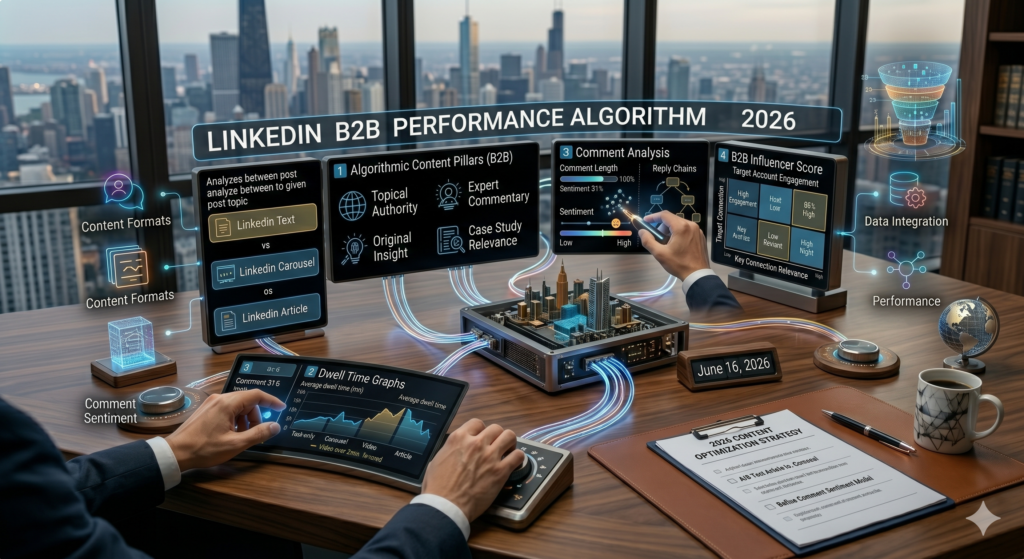
LinkedIn’s content algorithm went through significant changes in 2024 and 2025. The platform shifted from optimising for engagement volume to optimising for what it calls “knowledgeable engagement” with content matching user interests. A post with 50 thoughtful comments from people in the relevant industry now outreach a post with 500 generic likes from broader audiences.
This guide covers what works in 2026: content formats, posting cadence, the comment quality signal, and the specific patterns we have measured across client B2B accounts.
What LinkedIn measures
The current algorithm weights these signals:
Dwell time. How long users spend looking at the post in their feed before scrolling. Posts with long-form text or carousels that take time to consume get higher dwell scores.
Comment quality. Comments under 5 words count for little. Comments with substance (multiple sentences, original opinion, additional information) count for much more. The platform analyses comment text.
Engagement from relevant audiences. A comment from a Director of Marketing on a marketing post weighs more than a comment from a random connection. The platform classifies users by industry, seniority and topical interests.
Save and share signals. Saves indicate the content has lasting value. Shares indicate the content is worth amplifying. Both weight higher than likes.
Repeat engagement from your followers. Posts that consistently earn engagement from your existing follower base build cumulative algorithmic trust over time.
Content formats that work in 2026
Three formats consistently outperform others:
Long-form text posts. 1,200 to 3,000 character text posts with strong hooks, white-space formatting (line breaks every 1 to 3 sentences), and clear narrative or argument structure. These dominate B2B feeds. Production cost is low. Reach is the highest of any format for most B2B accounts.
PDF carousels. Multi-page PDFs uploaded as documents. Educational deep-dives, frameworks, checklists, or visual data presentations. Dwell time is high because users tap through pages. Saves are high because the content is reference material. 8 to 12 pages is the sweet spot.
Short-form vertical video. 30 to 90 second videos with captions burned in (most LinkedIn users watch without sound). Founder commentary, customer testimonials, educational moments. Reach has grown significantly through 2025 as LinkedIn pushed video discovery.
Formats that work less well: external links (LinkedIn deprioritises posts with off-platform links), image-only posts without compelling captions, video without captions, and any content that feels like an ad rather than a contribution.
The hook in the first two lines
LinkedIn’s mobile feed shows the first two lines of any text post before truncating with “…see more”. Users decide to expand based on those two lines. A post with a weak opening gets ignored regardless of content quality.
Patterns that work:
Specific number or claim. “I just spent 6 weeks rebuilding our cold email infrastructure. Here is what worked.”
Contrarian statement. “Most B2B marketers measure the wrong things. Here is what to track instead.”
Promise of utility. “12 ABM mistakes that cost us our biggest deal last quarter.”
Story opening. “On Tuesday, my biggest client cancelled. By Friday, I had figured out what went wrong.”
Personal narrative or vulnerability. “I made the wrong hire 6 months ago. Here is what it cost us.”
Avoid in opening lines: generic questions (“What do you think about X?”), corporate boilerplate, vague claims without specifics.
Posting cadence and timing
Consistency outperforms volume. Posting 3 times per week for 12 months produces better results than posting 12 times per week for 3 weeks.
Recommended cadence for B2B accounts:
Personal accounts (executives, founders): 4 to 5 posts per week. Mix of formats: 2 to 3 text posts, 1 carousel, 1 video.
Company accounts: 3 to 5 posts per week. Heavier on company news, product updates, customer stories. Lower organic reach than personal accounts but useful for ad retargeting and SEO.
Best posting times vary by audience geography. For US-based B2B audiences: Tuesday through Thursday, 8am to 10am ET or 12pm to 2pm ET. For India-focused: Tuesday through Thursday, 10am to 12pm IST. For UK: Tuesday through Thursday, 9am to 11am GMT.
Test posting times in your specific account using LinkedIn analytics. Audience patterns vary.
Personal vs company accounts
Personal account posts reach 2 to 10 times further than company posts on average. The implication: most B2B brand content should publish through executive and employee accounts, not the company page.
Strategy that works:
Leadership team posts on personal accounts 3 to 5 times weekly. Topics aligned with their actual role (CEO posts on strategy, CMO posts on marketing, Head of Engineering posts on technical topics).
Company page posts 3 times weekly. Focuses on company news, hiring, product updates, customer stories.
Employee advocacy programmes amplify both. Tools like GaggleAMP, Bambu and Hootsuite Amplify let employees easily share company content to their networks.
Cross-pollination: executives quote-share or react to company posts, increasing reach. Company page comments on executive posts, signalling alignment.
Comments as a content strategy
Comments on other people’s posts are a major reach lever. The pattern:
Identify 20 to 50 high-reach accounts in your target audience whose posts your prospects engage with. Industry leaders, influential creators, customer voices.
Comment substantively on their posts. Multi-sentence comments with original perspective, additional information, or thoughtful disagreement. These comments earn impressions from the original post’s audience.
Reply to other commenters on those posts. Continued conversation extends visibility and demonstrates topical interest.
Done consistently, this builds visibility without requiring more original posting. Many B2B founders we work with credit half their LinkedIn pipeline to commenting strategy, not their own posts.
Newsletter and creator mode
LinkedIn newsletters earn email-style reach. Subscribers get notified when you publish. For B2B brands building thought leadership, newsletters compound reach over months.
Newsletter cadence: weekly to bi-weekly works. Less frequent loses subscriber engagement.
Newsletter format: 600 to 1,500 word essays. More substantial than feed posts. Frequently repurposed from blog content or original analysis.
Creator mode (now Profile Creator mode) unlocks newsletter feature, follower count display, profile video, and topical hashtag selection. Enable it for any account doing meaningful content publishing.
Paid amplification of organic content
LinkedIn’s Thought Leader Ads format (launched 2023, expanded 2025) lets brands promote employee or executive posts as ads. The pattern that works:
Publish organic content from executive accounts. Wait 24 to 72 hours to measure organic engagement.
Promote the top-performing 10 to 20 percent as Thought Leader Ads with company budget. The ad runs as the same post, displayed to the targeted audience.
Cost per result is typically 30 to 50 percent lower than dedicated ad creative because the engagement signals from organic carry into paid distribution.
What does not work in 2026
Engagement pods. LinkedIn has improved detection of coordinated engagement. Pods that artificially boost early engagement get flagged and posts get suppressed.
Generic motivational content. “Success is a journey, not a destination” type posts reach little in 2026 because the audience-relevance signal flags them as generic.
External link clickbait. Posts that promise insight then redirect to a blog post for the actual content get deprioritised. Lead with the insight in the post itself.
Posting purely for engagement metrics. Comment counts mean less than they used to. Quality of audience engaged matters more.
What to expect
Reach for established accounts (5,000 plus followers, consistent posting): 10,000 to 50,000 impressions per post on average, with top posts reaching 100,000 to 500,000 impressions.
For newer accounts (under 2,000 followers, less than 6 months consistent posting): 1,000 to 5,000 impressions per post, with strong posts reaching 20,000 to 50,000 impressions.
Audience growth: 200 to 800 new followers per month for consistently posting B2B accounts. Quality of followers (relevance to ICP) matters more than count.
Pipeline contribution: across the B2B accounts we work with, LinkedIn organic typically contributes 15 to 30 percent of qualified pipeline within 12 months of disciplined posting. Higher for founder-led accounts in clearly defined niches.